
Sorry, but I do not agree with @Higgs in a total way. According to my theory, the second part is correct. In a semi-infinite solenoid, a field line crossing the endmost winding is a straight line perpendicular to the axis of solenoid: it can be demonstrated and shown that for distances greater than the radius of the solenoid, the field lines are perpendicular to the axis of the solenoid, which means that the field has zero axial component at

. So,

. All the steps taken by @Higgs in this regard are correct. The drawing below shows the plane of the coil as a dotted line, and points

and
approximately drawn to scale. The axial component (parallel to the axis of the solenoid) is zero at
and non-zero at
.
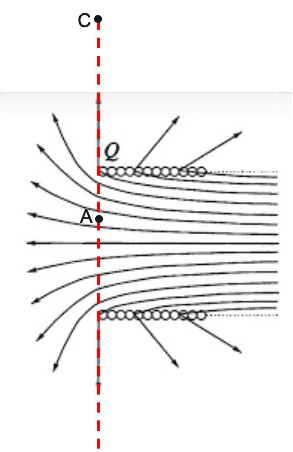
Unfortunately, I disagree on the first part. To begin with, an Amperian loop
in the plane ortogonal to axis containing just the last coil of solenoid
has no current cutting
through its plane so the enclosed current is zero. This is consistent with the fact that the component of the field at the circumference of the Amperian loop is radial, which means that the field vector

and the line element

are perpendicular to each other and
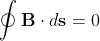
. So Ampere's law in this case gives

, which is not very helpful. Moreover, the equation

works for points far away from the ends, whereas the point of interest
is on the plane of the end of the solenoid at

.

I think it's a Meissner effect situation. The supercurrent provides a counter-flux that excludes all the flux that comes out of the solenoid. Half the flux in the solenoid goes out the sides, so we have to calculate how much current is needed to generate that amount of counter-flux. Since the radius

of the solenoid is much larger than the radius

of the coil, I think it is safe to calculate the counter-flux through the end of the solenoid using the expression for the field at the center of a ring of current. According to Lenz's Law, the current induced in the loop generates a counter-flux

that opposes the external flux

, which attempts to thread the loop. The net flux through the loop is equal to the difference of the external flux attempting to thread the loop and the counter-flux due to the induced current:

. In the case of a superconducting loop, its resistance is zero, then the opposition of the counter-flux to the external flux is complete and

remains constant perpetually. So, since the total flux through the superconducting loop remains constant at

(the reason for this is that any change in flux requires a nonzero emf around the loop, which requires in infinite current, so magnetic flux through the loop cannot change), the counter-flux of the loop must be equal and opposite to the external flux. So:

, with
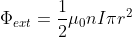
I would say that the magnetic field at the center of the loop is
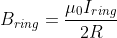
, that produces flux
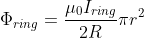
through the end of the solenoid. Since the flux through the loop must be zero:

Though, the value of self-inductance

provided by the text does not appear in this result, which is a problem.

If we have the supercurrent

and the radial field

at the loop, we can find the force as:

.
The key for this item is finding
on the dotted red line (see figure above) as a function of
. I don't know how to do that for large distances from the axis.
Could you post some hints about the observations I just put forward, so that I can begin to develop a real procedure?
 (the number of coils per unit length) is located coaxially with a circular superconducting coil of radius
  . Initially, there was no current in the coil. The inductance of the coil is equal to
  and then maintained constant. The wires supplying current to the solenoid are arranged in such a way that their magnetic field and their interaction with other elements can be neglected. Let's direct the
  axis as shown in the figure.
 and
and  , respectively, from the axis of symmetry of the system. Find the projections of induction
  and
and  of the magnetic field generated by the solenoid at points