Physicsguy51 ha scritto: ↑30 ago 2023, 5:07
We have a small ring made of thin wire having radius

and its inductance is

. Find the inductance of a ring having

-times the dimensions as this ring. If in the plane of the ring, we place another superconducting ring of half the geometric dimensions so that the planes of the rings and their centers coincide, then the inductance of the ring with radius
comes out to be

. What will the inductance

of the ring with radius
be when it is placed inside a superconducting ring with twice the geometric dimensions? The planes and centers of the rings also coincide in this case.
This problem has a medium-high difficulty coefficient, but it's striking, especially because of the challenging entanglements making up the puzzle.
Let us recall the formula for the inductance of a ring of radius
and wire cross-sectional area

, as given by:

, where

is the permeability of vacuum,

is the number of turns of the wire, and

is the length of the wire. For a single-turn ring, we have

,

and

, so the formula simplifies to:
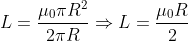
. Note that the inductance

of a ring is proportional to its radius

, so that

, because, according to

, the magnetic flux

through the plane of the ring is directly proportional to the radius
, so

. It is due to the fact that the magnitude of magnetic field

is inversely proportional to
(it decreases as the radius increases, in inverse proportion), so that relationship between magnetic field induction and geometrical dimensions is

, and the cross-sectional area

is directly proportional to

(it increases proportionally to the square of the radius), so that relationship between area and geometrical dimensions is

.
Now, suppose having another ring that has

-times the dimensions of the original ring, that means its radius is

, its cross-section area is
^2 = n^2 \pi R^2)
, and its length is

. Plugging these values into the formula, we get that, for
, the inductance of this ring is:
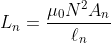

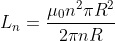
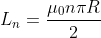
. Since
is equal to:

, we obtain:

So, the inductance of the scaled-up ring is
times the inductance of the original ring.
In a more general way, it can therefore be written:
 = nL (R)})
The placing of superconductors inside (smaller size) or outside (larger size) of an original ring, so that their planes and centers coincide, is the case involving concentric and coplanar rings, which make up a puzzle through which the starting ring changes its self-inductance depending on the loop in contact with it. The interest of the problem is to calculate the inductance
of a ring of radius
and self-inductance
when it is introduced inside a superconducting ring of twice the size (i.e., of radius

), after a superconducting disc of half the size (i.e., of radius

) has been put inside the conducting loop itself, such that the self-inductance of the medium-sized ring is equal to
. Hence, possible methods will have to be found to correlate the three currents

,

and

flowing, respectively, in the conducting ring of radius
, the inner superconducting loop of radius
and the outer superconducting loop of radius
: through the inductances
,
and
of the conductor, they will be led back to the evaluation of the magnetic fluxes

and

through the plane of the ring of radius
in the presence of the coils of radii
e
, respectively. In order to calculate those, however, it is necessary to consider, preliminarily, the magnetic fluxes through the common plane with a region having outer radius
and inner radius
(this flux, which will be called

, is preparatory for the calculation of the flux
) and a region with outer radius
and inner radius
(such a flux, which will be denoted

, will be necessary for the evaluation of the flux
). Between calculating the fluxes through
the only regions of the ring with smaller inner radius and larger outer radius, and calculating the fluxes through the plane of the ring in the presence of the two superconductors, the intermediate step is given - as one might assume - by figuring out the net fluxes, constant at

,

and

through the inner (of radius
) and outer (of radius
) regions, respectively, bounded by the superconducting rings (of equal respective sizes).
The magnetic flux

through the plane of the ring of radius
with inductance
and into which a current
flows, is equal to:

. Therefore:
1) the flux

of the magnetic field through an inner region of the original ring (of radius
) comparable to a circular loop of radius
, coplanar and concentric to it, will be a positive fraction of the total flux
, defined by a multiplicative factor

such that

.
2) The flux

of the magnetic field through a region outside the original ring (of radius
) comparable to a circular disc of radius
, coplanar and concentric to it, will be, analogous to the previous, a positive fraction of the total flux
, defined - this time - by a multiplicative factor

such that

.
So:
1)

, with
.
2)

, with
.
Hence it follows that

is the factor that sets the flux

of the ring of radius
due to that of radius
, and that

is the factor defining the flux

of the ring of radius
due to that of radius
.
In conclusion, regarding 1), the flux
of the magnetic field through the plane region with outer radius
and inner radius
will be given by the difference between total flux
and inner flux
through the circle of radius
. Symbolically:


 \Phi_{\text{tot}})
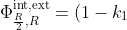 LI)
.
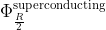
The net internal flux
through the inner region of radius
of the conducting ring bounded by the superconductor of same radius is given by the difference between the flux
through the circle of radius
and the flux
through the inner superconducting ring of radius
, equal to
 I_1)
.
Since it has been proved that the inductance of a ring with dimensions
-times larger than a starting ring is equal to
times the inductance of the latter, then, for a ring with geometric dimensions of half the size of an original correspondent, i.e., for

, we have:
 = n L(R))
 = \frac{L}{2})
. Substituting in
, we have:
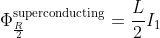
. Therefore:

, with

. So:





)
.
Since the coil of radius
through which current
flows, assumes inductance
when the superconducting ring of radius
is placed inside it, then the magnetic flux
through the plane of the first one, corresponding to the total flux relative to the original ring in the presence of the smaller superconductor, is given by:

. That same flux is given by the sum of the magnetic flux
through the plane region with outer radius
and inner radius
and the flux
through the superconducting ring of radius
due to that of radius
. The latter flux is given by a fraction of the flux
through the inner superconducting ring of radius
, defined - as already analyzed - by the coefficient
. Therefore:

. Ultimately, we have:

 LI + k_2 \frac{L}{2} I_1)
.
By equating the two expressions for
, we have:
 LI + k_2 \frac{L}{2} I_1)
 LI + k_2 \frac{L}{2} I_1)
)
Substituting
into
, we have:
 LI + k_2 k_1 LI)
 LI)
 L)
] L})
.
By means of the mutual induction approach, it is possible to obtain, for
, a result similar to that just calculated, with a significantly smaller number of steps. Let

be the mutual inductance coefficient of the two electrically separated circuits consisting of the loop of radius
and the superconducting loop of radius
, such that

, i.e., that the mutual inductance coefficient

of the conducting ring of radius
on the superconductor of radius
is equal to that

of the latter on the former. Therefore, the internal flux

through the circle of radius
is given by the product of the mutual inductance coefficient
and the current
flowing through the original ring. In symbols:
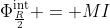
.
In analogy to what we saw earlier with expression (1), we have that:
, with
and
. Therefore:

, whence:

)
.
As discussed previously, the magnetic flux
through the plane of the ring of radius
, corresponding to the total flux relative to the original ring in the presence of the superconductor of radius
, is given by:
. This same flux is given by the difference between the magnetic flux
through the plane of the ring of radius
with inductance
and in which a current
flows and the magnetic flux

through the plane region with outer radius
and inner radius
and internally bounded by the superconducting ring of radius
. Therefore:

.
Equalizing the two expressions for
, we have:

)
.
Substituting
into
, we have:

.
Picking up 2), the flux

of the magnetic field through the plane region with outer radius
and inner radius
will be given by the difference between total flux
and outer flux
through the circle of radius
. In symbols:

 \Phi_{\text{tot}})
 LI)
.
The net external flux
through the outer region of radius
of the conducting ring bounded by the superconductor of the same radius is given by the difference between the flux
through the region with outer radius
and inner radius
, and the flux
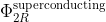
through the outer superconducting ring of radius
, equal to
 I_2)
.
Since it has been shown that the inductance of a ring having dimensions
-times larger than a starting ring is equal to
times the inductance of the latter, then, for a ring having geometric dimensions twice the size of an original counterpart, that is, for

, we have:
 = 2L)
. Plugging it into
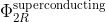
, we have:

. Therefore:

, with

. So:


 \Phi_{\text{tot}} = 2L I_2 \Rightarrow 2L I_2 = (1-k_2) LI)
)
.
Since the loop of radius
in which current
flows acquires inductance
when the superconducting ring of radius
is placed inside it, then the flux
of the magnetic field through the plane of the former, corresponding to the total flux relative to the original ring in the presence of the larger superconductor, is given by:

. This same flux is given by the difference between the flux
of the magnetic field through the plane of the ring of radius
having inductance
and in which a current
flows, and the flux
through the superconducting ring of radius
due to that of radius
. The latter flux is given by a fraction of the flux
through the outer superconducting ring of radius
, defined - as already examined - by the coefficient
. So:

. Ultimately, we have:


.
Equalizing the two expressions for
, we have:


)
.
Substituting
into
, we have:
 LI)

] L I)
] L})
.
For
it is also possible to arrive at a similar result to that calculated by a procedure similar to the one used for the case of
, that is, by evaluating mutual induction. If
is the mutual inductance coefficient of the loop of radius
and the superconducting ring of radius
, such that

, then the coefficient of mutual inductance of the conducting ring of radius
and the superconducting ring of radius
will be

, such that

, i.e., that the mutual inductance coefficient

of the conducting loop of radius
on the superconductor of radius
is equal to that

of the latter on the former. Let
1 and
2 be the circuit configurations consisting of conductor loop of radius
and superconductor loop of radius
, and conductor loop of radius
and superconductor loop of radius
, respectively: the multiplicative factor

will be calculated so that the product of the circuit sizes in configuration
2 is equal to the product of the circuit sizes in configuration
1 enlarged

times. Therefore, with

,

and

,

, we have:


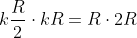




since
. Therefore,

Therefore, the external flux

through the circle of radius
is given by the product of the mutual inductance coefficient

and the current
flowing through the original ring. In symbols:

.
As seen above with the expression
, we have that:

, with

and
. Therefore:



, from which:

)
As discussed before, the flux
of the magnetic field through the plane of the ring of radius
, corresponding to the total flux relative to the original ring in the presence of the superconductor of radius
, is given by:
. That same flux is given by the difference between the flux
of the magnetic field through the plane of the ring of radius
with inductance
and in which a current
flows and the flux

of the magnetic field through the plane region having outer radius
and inner radius
and externally bounded by the superconducting ring of radius
. Therefore:

.
Equalizing the two expressions for
, we have:

)
.
Substituting
into
, we have:

.
Comparing the two expressions for
and
, it can be seen that they are equal. Therefore, we arrive at the relation:

.